


Erasmus+ 2026 Programme Guide: Key Changes, KA1 & KA2 Deadlines
We compared it with the 2025 version, checked the small print, and highlighted what is really important for school leaders, Erasmus+ coordinators and teachers. In this updated overview, we bring you:
- the main changes for 2026
- the key rules from 2025 that still apply
- and the KA1 and KA2 deadlines for 2026 you must not miss.
Erasmus+ 2026 in a nutshell
On 12 November 2025 the European Commission opened the Erasmus+ 2026 call for proposals, with a budget of around €5.2 billion for the year.
The big picture stays the same. Erasmus+ still focuses on four main priorities:
- Inclusion and diversity – real access for learners with fewer opportunities.
- Digital transformation – digital skills, AI in education, smart use of online tools.
- Environment and the fight against climate change – green competences and sustainable behaviour.
- Participation in democratic life – civic engagement, media literacy and EU values.
The core message for KA1 learning mobility in 2026 is:
Mobility must be inclusive, green and digital – not only in theory, but in your project design, activities and budget.
Good news: there is no full “reset” of the programme.
- Key Actions (KA1, KA2, KA3 and Jean Monnet) stay the same.
- The main KA1 formats (KA121 accredited projects, KA122 short-term projects) and KA2 structures continue.
But inside this stable structure, there are important changes and clarifications that can strongly influence the success of your project.
New and clarified KA1 rules for 2026
The new Programme Guide brings several concrete updates for KA1 mobility projects starting in 2026. These affect school education, adult education and VET alike and apply both to new applications (deadline 19 February 2026) and to already accredited organisations.
2.1. Job shadowing: maximum 2 participants per mentor
For all sectors, there is now a clear limit:
- Maximum 2 participants can shadow the same mentor at the same time.
This does not mean you cannot send more staff to the same school or host organisation. It simply means:
- If you send 4 teachers at the same time, they should shadow at least 2 different mentors (for example, two shadow the English teacher, two shadow the head of department).
This rule helps keep job shadowing practical, personalised and meaningful.
2.2. The host organisation must really lead the mobility
The 2026 Guide repeats and strengthens an important principle:
All learner and staff mobilities must be hosted by an organisation abroad, and the staff of the hosting organisation must be in the lead role.
In practice, this means:
- The host school, centre or training provider must actively organise and guide activities – not just rent a room or “sign the papers”.
- For example, during a job shadowing, their staff should open their classrooms, show methods, explain documents and answer questions.
For Platform21 courses in Split, Zagreb, Reykjavik and Cappadocia, this is already part of our culture:
our trainers and partner schools actively welcome participants, share real practice and co-create activities – not only deliver a slideshow.
2.3. Subsidiaries of the sending organisation cannot “pretend” to be transnational hosts
Another important clarification for KA1:
- Subsidiaries, branches or entities linked to the sending organisation cannot act as hosting organisations if they do not meet the basic condition of transnational mobility.
In simple words:
- You cannot send staff from School A to “School A – branch in another country” and call it a transnational mobility if the structure is basically the same legal entity.
- The idea of Erasmus+ mobility is exchange between different organisations, not “internal travel”.
2.4. Adult education: proof of working relationship
For the adult education sector, the 2026 Guide makes expectations clearer. National Agencies must be able to verify the link between the participant and the sending organisation, for example through:
- a work contract
- a volunteer agreement
- a task description
- or similar documentation.
This is not a new restriction, but a clear reminder:
- If you send adult educators (including volunteers), make sure you can show written proof that they really work with your organisation.
2.5. Adult learners: no extra funding for local travel inside the host country
For group mobility of adult learners, the Guide clarifies that:
- Activities must take place at the hosting organisation.
- If, for pedagogical reasons, some activities take place at another venue in the same country (for example, a visit to another centre), extra local travel costs are not funded as transnational mobility.
In other words:
- You can still move within the host country for learning activities,
- but you cannot claim extra Erasmus+ travel money for those internal trips.
This applies both to group and individual adult learner mobilities.
2025 changes that still apply in 2026 (and you should not forget)
A few reminders of several important rules first introduced in 2025 for KA1 projects. They continue to apply in 2026, so your planning must respect them.
3.1. Funding limits for “Courses and training” (School & VET only)
For school education and VET:
- The total budget you can use for the category “Courses and training” is limited to maximum 50% of the awarded project grant.
- Exception: for projects with total awarded grant up to 40,000 EUR, the limit is 20,000 EUR.
This rule does not apply to adult education projects.
What does this mean for you?
- You cannot build a KA1 project only around staff courses abroad.
- You need a balanced plan that includes staff and learner mobilities, job shadowing and other forms of learning.
A practical rule of thumb often used is:
- For each mobility “flow”, plan roughly 1 teacher for every 2–3 students (depending on distance and other costs).
3.2. Maximum participants per course
Another rule that stays:
- Maximum 3 participants from the same organisation
- or 10 participants from the same consortium can attend the same course.
You can still bring bigger groups to Platform21 courses, but they should:
- attend different courses, or
- join different course weeks, or
- combine course + job shadowing, depending on your project design.
This rule is here to guarantee a real international mix and strong networking – not a closed group from one school.
3.3. One course per participant per project
Each staff member can only attend one course per project.
If you want a deeper experience for the same person, you can:
- choose a longer course (for example 6–7 days instead of 5), or
- combine one course with job shadowing in the same project, as long as this matches the rules and your budget.
3.4. KA1 activities must be truly transnational
The Programme Guide also reminds us that KA1 activities must have a clear transnational component. This means:
- international groups of participants,
- interaction with staff from the host country,
- and real exchange of practices, not only tourism.
At Platform21, we always build our courses with:
- mixed groups of teachers from different countries,
- cooperation with local schools and partners,
- and active sharing of classroom practice.
3.5. Group vs individual mobilities for adult learners
The Guide also clarifies something that often creates confusion: the difference between group and individual adult learner mobilities.
- Group mobility of adult learners
- simpler activities, using existing resources and content,
- lower organisational support (125 EUR per person),
- good for collective and informal learning.
- Individual mobility of adult learners
- each participant has their own learning programme,
- higher organisational support (350 EUR per person),
- better for tailored, more intensive learning paths – even when several learners travel together.
The key point:
The difference is not how people travel or where they sleep.
It is in the design of activities (group vs individual learning programme).
Other key 2026 priorities you should reflect in your project
Besides the KA1 technical rules, the 2026 Guide makes several strategic priorities much more visible than before. If you want a high score, they must be present in your application.
4.1. Mental health and wellbeing as a clear priority
In 2026, mental health is no longer hidden between lines. The Guide expects school and VET projects to address:
- social and emotional learning (SEL)
- cyberbullying and safe online behaviour
- psychological safety at school
- teacher wellbeing and burnout prevention.
In your application, don’t stop at one general sentence. Show clearly:
- Which needs related to wellbeing you identified,
- Which activities you will implement (workshops, tools, policies, support systems),
- How you will measure change (surveys, observations, feedback).
4.2. Girls in STEM: from slogans to real actions
The 2026 Guide gives more weight to gender equality in STEM.
For STEM-related projects you should:
- present basic data (for example, percentage of girls in your STEM classes or VET profiles),
- plan concrete activities (STEM clubs, mentoring, role models, visits, career guidance),
- define indicators to follow (interest, participation, future subject choices).
Evaluators want to see real strategy, not only “we will encourage girls to join STEM”.
4.3. Green travel below 500 km
The green dimension is stronger in 2026. The general rule is:
For distances under 500 km, train or another green travel option is now the expected choice.
You can still use flights, but you should:
- explain why (for example, no reasonable train connection, island context),
- and show that you at least considered greener alternatives.
Your transport choices can now influence your scores for relevance and quality, not only the budget.
4.4. Inclusion and diversity with more weight in scoring
Projects that clearly target participants with fewer opportunities (economic, geographical, migrant background, SEN, etc.) receive stronger relevance scores.
In KA1, there is also a small but important technical detail:
- Inclusion support for participants (extra costs to involve disadvantaged participants) is not counted inside the 50% limit for “Courses and training”.
This gives you more room to:
- make your mobilities truly inclusive,
- without being “punished” in the training budget.
4.5. New KA2 action: European Partnerships for School Development (EPSD)
One of the most interesting KA2 updates is the introduction of European Partnerships for School Development (EPSD).
These projects help schools:
- integrate cross-border activities (for staff and pupils) in everyday school life,
- create mobility windows in the school year,
- test and share innovative methods and basic skills strategies across countries,
- build long-term networks for exchange.
If your school already has experience with KA1 mobilities and wants to move to a more systematic, long-term European strategy, EPSD can be a natural next step.
4.6. Union of Skills, Preparedness Union, micro-credentials, CBHE
The 2026 Guide places Erasmus+ inside a wider EU policy context, including:
- Union of Skills – focus on skills for quality jobs, lifelong learning and cooperation with employers.
- Preparedness Union Strategy – resilience of education systems during crises (health, wars, climate).
- Micro-credentials – short, recognised learning units, especially in VET and adult education.
- Capacity Building in Higher Education (CBHE) with 3 strands, including STEM Skills Foundries that connect universities, innovation and entrepreneurship.
For most schools and adult education centres, this means:
- Projects that link skills for the green and digital transition,
or improve resilience (crisis planning, digital readiness, mental health systems)
fit very well with the new Erasmus+ direction.
KA1 and KA2 deadlines for 2026
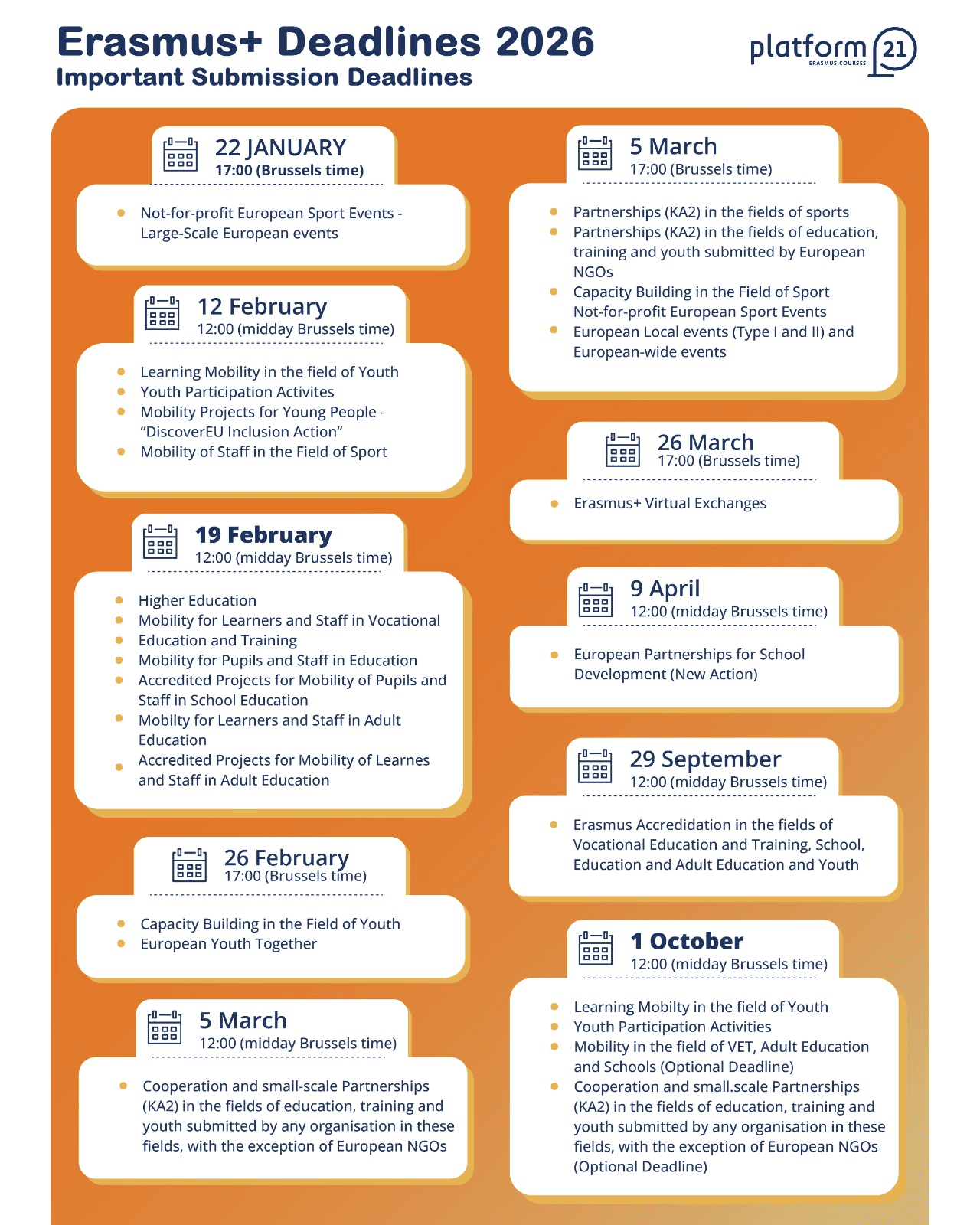
According to the Erasmus+ 2026 Call and National Agency summaries, the main deadlines for education and training are:
KA1 – Learning Mobility of Individuals
- 19 February 2026, 12:00 (midday Brussels time)
This deadline covers:
- KA121 accredited mobility projects
- KA122 short-term mobility projects
for school education, VET, adult education and higher education.
(Some National Agencies may also organise a second round in the youth field later in the year; always check your National Agency’s website.)
KA2 – Cooperation Partnerships and Small-scale Partnerships
- 5 March 2026, 12:00 (midday Brussels time)
This is the main deadline for KA2 projects in education and training. Some countries may offer a second deadline for Small-scale Partnerships, often around early autumn – again, check locally.
Quick checklist for your 2026 project draft
When you sit down with your KA121/KA122 or KA2 draft, use this checklist:
- Mental health & wellbeing
- Is wellbeing visible in your needs analysis and activities, not just in one sentence?
- Inclusion & participants with fewer opportunities
- Have you clearly described who they are and how you will support them (including the inclusion budget)?
- Green travel decisions
- Are mobilities under 500 km planned by train or other green options unless there is a strong reason not to?
- Gender equality in STEM (if relevant)
- Do you have basic data, clear actions and measures for girls in STEM, not only a promise?
- KA1 rules from 2025
- 50% cap for Courses and training (School & VET),
- max 3 participants per organisation per course (10 per consortium),
- 1 course per person per project,
- respect for the transnational component.
- KA2 strategy (including EPSD)
- Are you ready for European Partnerships for School Development or another KA2 format that supports your long-term goals?
- Deadlines
- Is your internal calendar aligned with:
- 19 February 2026 – KA1
- 5 March 2026 – KA2
- Is your internal calendar aligned with:
How Platform21 can support your next Erasmus+ steps
At Platform21 – Erasmus+ Teacher Training Centre, we work with schools, kindergartens, VET centres and adult education providers across Europe. Our mission is simple:
- To provide the best learning, training and networking experience for educators and learners
- to connect EU priorities (inclusion, digital, green, participation) with real classroom practice,
- and to support schools in building a long-term European development plan, not just one project.
We offer:
- KA1 teacher training courses in Split, Zagreb, Reykjavik and Cappadocia,
- job shadowing and school visits,
- Invited Expert visits directly to your school,
- and tailor-made guidance for Erasmus+ coordinators and school leadership teams.
If you want to:
- update your KA121 or KA122 mobility plan for 2026,
- design a KA2 Cooperation Partnership or European Partnership for School Development,
- or simply understand what the 2026 Programme Guide means for your school,
you are warmly invited to join us at one of our courses or contact us for support.
Erasmus+ 2026 is built on familiar foundations, but expectations are higher.
With the right partners and a clear plan, your next project can be both funded and transformative for your school community.
If you still don’t know where to begin, check out our blogs:
https://erasmus.courses/blog/how-to-apply-for-an-erasmus-ka1-grant/
https://erasmus.courses/blog/how-to-write-a-successful-erasmus-project-proposal-ka121-ka122/
Content
- Erasmus+ 2026 in a nutshell
- New and clarified KA1 rules for 2026
- 2025 changes that still apply in 2026 (and you should not forget)
- Other key 2026 priorities you should reflect in your project
- KA1 and KA2 deadlines for 2026
- Quick checklist for your 2026 project draft
- How Platform21 can support your next Erasmus+ steps
Tags
You may also like:
Erasmus+ Invited Expert in Talsi, Latvia: Innovative Teaching (10–12 Nov 2025)

Best free AI tools for teachers 2026: Free teachers' toolbox
The 2026 Erasmus+ Roadmap: 5 Key Priorities for KA1 Application

How to write a successful Erasmus+ project proposal (KA121/KA122)
Inside Iceland’s Education System: Trust, Nature, Clarity

Erasmus+ Programme 2028 – 2034 proposal: What to expect
A teacher training course in Iceland: A week to remember in Reykjavik

Erasmus+ Teacher Training Mobility with Platform21- Top 5 Reasons Why Croatia Is a Hidden Gem