

Teacher well-being starts here: build resilience, prevent burnout and manage stress
Teacher well-being starts here: build resilience, prevent burnout and manage stress
Teaching is meaningful work. But let’s be honest: it is also emotionally demanding.
Teachers give their time, energy, patience, and care every single day. They support students, manage behaviour, solve problems, meet deadlines, and often carry stress quietly in the background. After a while, that pressure can become too much. That is why teacher well-being is not a luxury. It is a necessity.
At Platform21, we believe teachers need more than advice like “try to relax” or “take better care of yourself.” They need practical tools that truly help. Our courses on resilience, mindfulness, stress relief, and burnout prevention are built around that idea: useful strategies, real reflection, and methods teachers can use both for themselves and for their students.
Teachers need care too
In many schools, teachers are expected to stay calm, positive, organised, and strong no matter what. But teachers are not machines.
They get tired. They feel pressure. They doubt themselves. They have hard days. And when stress keeps building without enough recovery, burnout can slowly appear.
That is why this conversation matters. Teachers cannot keep giving their best to others if they are constantly running on empty.
Self-compassion is not selfish
Many teachers show kindness to everyone except themselves. They are patient with students, supportive of colleagues, and understanding with parents. But when they make a mistake, they become their own biggest critic.
This is where self-compassion becomes so important.
Self-compassion means speaking to yourself with the same kindness you would offer to someone else. It means noticing when you are struggling and not adding extra shame on top of stress. It means accepting that a hard day does not mean you are a bad teacher.
This is not weakness. It is a healthy skill. Teachers do not only need classroom tools. They also need ways to protect their own emotional energy.
Journaling can help more than people think
Journaling is often seen as something small. But sometimes small habits help the most.
When teachers write things down, they slow down. They begin to notice what is really happening inside them. They can name emotions, reflect on difficult moments, and see patterns more clearly.
A journal can be a simple but powerful space for questions like:
- What drained me today?
- What helped me feel calm?
- What am I carrying into tomorrow?
- What went well, even in a small way?
- What do I need more of this week?
Teachers often keep everything in their heads. Journaling helps bring thoughts out into the open. It creates space to breathe, reflect, and reset.
Burnout prevention should begin before burnout
One of the biggest mistakes teachers make is waiting too long. They tell themselves they are just tired, that next week will be easier, or that they only need to push a bit more.
But burnout rarely arrives all at once. It grows slowly through emotional exhaustion, stress, frustration, and lack of recovery.
That is why teachers need practical steps they can use early: mindful pauses, reflection, emotional awareness, stronger boundaries, calm routines, movement, and support from others. Prevention is always better than repair.
Nature helps us slow down
Sometimes the most helpful thing is also the simplest: step outside.
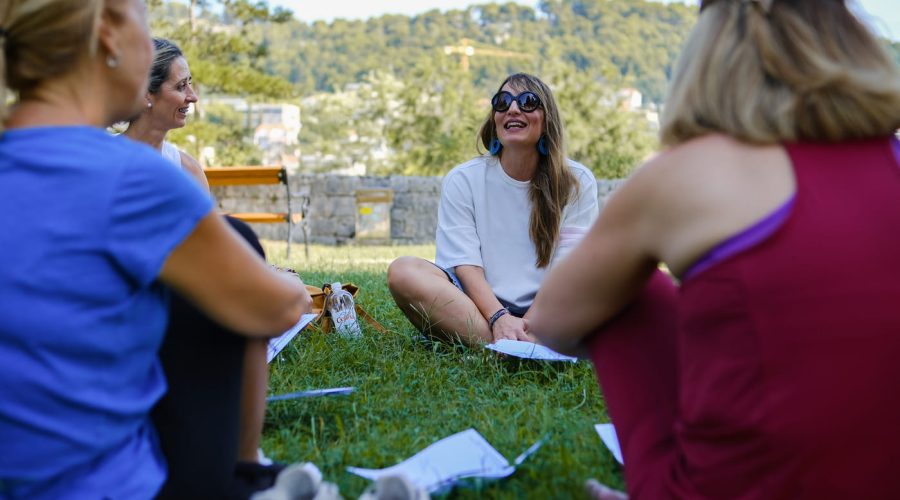
Nature gives the mind a break. It helps the body slow down. It brings quiet into busy days. A short walk, a lesson outdoors, a few minutes in a park, time near the sea, or a mindful moment under the trees can all become real tools for stress relief and emotional balance.
At Platform21, our well-being and resilience courses include outdoor learning, nature-based reflection, mindful movement, and beautiful learning spaces in Split. Nature is not just a nice background. It helps teachers reconnect with themselves and bring that calm back into the classroom.
Well-being in schools must be practical
This is where many schools fall short. They talk about well-being, but often in a very general way. The message sounds good, but teachers are left with little they can actually use.
That needs to change.
Well-being should be practical. It should give teachers strategies they can try in real life: mindfulness for busy days, journaling for reflection, self-compassion after difficult moments, stress management routines, emotional awareness tools, nature-based practices, and ideas for calmer, more positive classrooms.
That is exactly the kind of approach we believe in at Platform21. Not empty theory. Not unrealistic advice. Practical methods that fit real school life.
Join us in Split
If you are looking for practical ways to support your well-being, prevent burnout, manage stress, and create more positive learning spaces, join us at Platform21 in Split.
Our courses bring together practical solutions for teacher well-being, burnout prevention, mindfulness, resilience, stress management, and positive school spaces. You will explore methods you can actually use, reflect on your own needs, connect with other educators, and leave with ideas that support both you and your students.
Come and learn with us in Split, and give yourself the same care and attention that you so often give to others.
Content
- Teacher well-being starts here: build resilience, prevent burnout and manage stress
- Teachers need care too
- Self-compassion is not selfish
- Journaling can help more than people think
- Burnout prevention should begin before burnout
- Nature helps us slow down
- Well-being in schools must be practical
- Join us in Split
Tags
You may also like: